|
 |
 |
|||
 |
 |
 |
|||
|
Overview of the 'National Framework for Values Education in Australian Schools' In 2002 Brendon Nelson commissioned a Values Education Study, which was unanimously supported by state and territory ministers in the Ministerial Council on Education, Employment, Training and Youth Affairs (MCEETYA).
The purpose of this study was to:
(2003 The Values Education Study Final Report p.1)
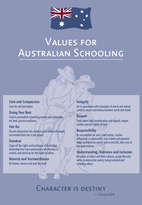
The National Framework for Values Education in Australian Schools was developed from the outcomes of the Values Education Study as well as from widespread consultation on a draft framework. There are nine values in total. The values have been selected in two ways:
The values are listed as they appear on posters across Australian Schools (in alphabetical order):
According to the Framework, the values are a reflection of the ideas and philosophies that underpin Australian society: “These shared values…are part of Australia’s common democratic way of life, which includes equality, freedom and the law of rule. They reflect our commitment to a multicultural and environmentally sustainable society where all are entitled to justice.” The purpose of the Framework is to:
(DECS 2005 p.1)
The National Framework for Values Education in Australian Schools outlines their vision for values education within the document as follows: All Australian schools provide values education in a planned and systematic way by:
(DECS 2005 p.3)
Within the wider community there is much discussion about how children acquire their values and their reaction to the values promoted by the media and their peers. According to the National Framework for Values Education in Australian Schools (2005 p.2) values education is an essential part of effective schooling as although “parents, caregiver and families are the primary source of values education for their children…they expect support from schools in this endeavour.”
From the study a number of draft principles for the framework were developed. These included guiding principles for the improved provision of values education in Australian schools, as well as the development of shared values to be fostered in Australian schools. Values are often highly contested, and in an increasingly value-laden world, Australia’s schools cannot operate as value-free zones. The Values Education Study identified some common values that were being fostered by Australian schools. A discussion about implementing The Nine Goals for Australian Schooling in schools and the classroom follows. Please go to the "Implementation” page. |
|||||
 |
|||||
 |
|||||
 |
|||||
 |
|||||
 |
|||||
 |
|||||
 |
|||||
 |
|||||
 |
|||||
 |
|||||
 |
|||||
© Copyright Beth Eastwood 2007. |
|||||