|
 |
 |
|||
 |
 |
 |
|||
|
A History of Values Education in Australia Values education, as we call it here in Australia, is also known around the globe as Moral Education, Character Education or Ethics Education. Over the last 20 years there has been a “growing belief that entering into the world of personal and societal values is a legitimate and increasingly important role for teachers and schools to play” (Lovat & Toomey 2007, p.xi). 1880 NSW Public Instruction Act 1880 : This act “stressed the need for students to be inculcated into the values of their society, including understanding the role that religious values had played in forming the society’s legal codes and social ethics” (Lovat & Toomey 2007, p.xii). According to Lovat and Toomey (2007), this evidence suggests that “public education’s initial conception was of being the complete educator; not only of young people’s minds but of their inner character as well”. Early 1990s During the early 1990s Australian states and territories were keen to define and promote the essential values which underline what it means to be an Australian. Much debate occurred (and is still occurring) in regards to whether values education should be free standing or whether these promoted values should be integrated into the mainstream syllabuses. There has been, and continues to be, a variety of forms designed and trialed at different levels of the system. According to Lovat and Toomey (2007), there is a continuing belief that “public schooling was designed essentially as a haven of values-neutrality” (Lovat & Toomey 2007, p.xi). Also, there continues to be “skepticism about the capacity of any school to manage, and have impact in, an area that is commonly seen as being totally subjective and therefore un-testable” (Lovat & Toomey 2007, p.xi). 2000 During early 2000, Australian states and territories “responded to both community pressure and the realization that values-neutrality is an inappropriate ethic and re-stated the original view that public education’s charter includes responsibility for personal integrity and social justice” (Lovat & Toomey 2007, p.xii). 2002 The 2002 Yearbook of the supreme professional body of teachers, the Australian College of Educators, was entirely devoted to the promotion of, and need for, Values Education in Australian schools. 2003 A highly important moment of the Values Education movement occurred in 2003, when the Australian Government issued a report on Values Education. This report, the Values Education Study, was developed by the Curriculum Corporation (Lovat & Toomey 2007, p.xii). 2004 In the 2004 Federal Budget, there was an allocation of $29.7 million for a Values Education program. 2005 National Framework for Values Education in Australian Schools developed and introduced in all Australian schools.
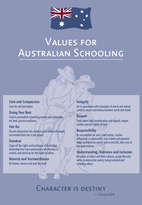
Today The question still remains about how, why and whether teachers should be teaching values in their classroom, and how schools should address values education. However, at the very least, every classroom should now be displaying a poster which contains the 9 Australian Values which are part of the National Framework for Values Education in Australian Schools.
|
|||||
 |
|||||
 |
|||||
 |
|||||
 |
|||||
 |
|||||
 |
|||||
 |
|||||
 |
|||||
 |
|||||
 |
|||||
 |
|||||
© Copyright Beth Eastwood 2007. Information by Erin Copeland, Sarah Craddock, Erin Doherty, Beth Eastwood, Sophie Russell and Annalisa Sheridan. |
|||||